
Romans 5:12 – Therefore, just as sin came into the world through one man, and death through sin, and so death spread to all men because all sinned –
Welcome back, dear readers! So far in this letter, Paul has shown that man has no means to justify himself in God’s sight. But there is good news. He has also clearly established the doctrine of justification by faith in Christ. He is now in the midst of showing us the benefits of this doctrine. Here is what he has shown so far: 
- Justification by faith produces peace (Romans 5:1).
- Justification by faith produces joy in us because of the assurance of future glory (Romans 5:2).
- The joy and assurance we receive sustains us during afflictions and hardships (Romans 5:3-4).
- Justification by faith includes the invaluable ministry of Holy Spirit in our lives (Romans 5:3-4).
- Justification by faith guarantees our salvation, because Christ died for it (Romans 5:6); this is the highest expression of the love of God for us (Romans 5:7-8).
- Justification by faith restores the relationship between God and man, making us the children or friends of God (Romans 5:9-10).
- Being the children/friends of God gives us peace and joy; it allows us to rejoice in God himself (his character and attributes) (Romans 5:11).
As we move on, here is something to keep in mind: many bible scholars consider the rest of this chapter to be one of the most difficult passages in the entire New Testament. It is highly unlikely that we will fully understand every single nuance of meaning that Paul is expressing in this passage. Nevertheless, there is still benefit in studying it. Whatever level of wisdom and insight we discover is not only useful now, it can also be used as a foundation for future study. So, let’s dig in.
Beginning in verse 12 Paul gives us the bigger picture. He shows the great evil which was introduced into the world by sin, and then proceeds to prove that the benefits of atonement/justification are far greater than the evil mankind allowed into the world. Keep this in mind – it is the general scope of the remainder of this chapter.
Paul’s goal is to call our attention to the work of Christ and the plan of justification he brought forth. Paul will show that as evil as sin is, the atoning work of Christ is far superior. It is bigger, greater, deeper, richer, fuller and more glorious than anything we have considered so far. It is the greatest gift that has ever been given.
His point is made through a comparison of the ‘first’ Adam (who allowed sin into the world – see verse 12) and the ‘second’ Adam, Jesus Christ (who brought life and righteousness into the world – see verse 17). Through some complex reasoning, Paul proves what was lost by Adam is fully restored by Jesus. As a secondary theme, Paul also continues to show that both Jews and Greeks/Gentiles find redemption through Christ.
GENERAL SUMMARY: Adam was responsible for allowing sin into the world. Sin, in turn, brought death into the world. From that moment forward, every single person who was born was born a sinner. Because we are all sinners, we are all under the curse of death.
DIGGING DEEPER: Just as sin came into the world through one man: Most of you reading this blog are familiar with the sin of Adam and Eve. However, now is a good time to give ourselves a quick reminder of the facts.
God created Adam from the dust of the ground (Genesis 2:7). He made Eve using the rib of Adam (Genesis 2:21-22). This couple was given the task of managing the garden of Eden on behalf of God (Genesis 1:27-28, Genesis 2:15). They were allowed to eat all of the produce of the land with one notable exception: They were not to eat from the tree of the knowledge of good and evil which was in the middle of the garden:
Genesis 2:16-17 – And the Lord God commanded the man, saying, “You may surely eat of every tree of the garden, but of the tree of the knowledge of good and evil you shall not eat, for in the day that you eat of it you shall surely die.”
(Keep this verse in mind because it plays a central role in Paul’s discussion.) Through the serpent, Satan planted seeds of doubt in Eve’s mind/heart about the goodness, truthfulness, faithfulness and love of God. She apparently relayed these thoughts to Adam and the two of them chose to rebel against God by eating from the tree (Genesis 3:1-7). Through their actions, sin entered the world and it affected the entirety of creation – mankind, the animal kingdom and the earth itself. This is often called the original sin. 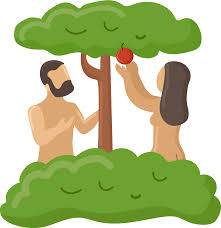
It might be argued that Eve was the first to sin, so she should be used as Paul’s example. But the thing to keep in mind is that Paul is not showing the order in which sin entered the world, but how it was propagated or passed down to future generations. Since man sows his seed into the woman and thus propagates the next generation of humans, sin is said to be passed through Adam.
And death through sin: The end result of sin is always death (Romans 6:23, James 1:15, I Corinthians 15:56). In fact, sin and death are inseparable; they are like Siamese twins, so when sin came into the world death automatically came too. This is true in both a physical and spiritual sense.
Physically, every single person will die. In some sense, we could say that we are physically born into death, because death is the final outcome for every person.
The same is true spiritually. We are born into sin, which has alienated us from God. Unless we are justified by faith in Christ Jesus, we will remain under the curse of spiritual death for eternity.
So death spread to all men: In our current study, the critical thing to understand is this: Adam was more than just an individual. He was the father of the human race. Everything he did affected his offspring.
At the beginning of creation, Adam received the gifts of God, the calling/authority of God (as manager/steward of the earth) and the favor of God on behalf of all mankind. In other words, these blessings were to be transferred from him to all future generations of his offspring.
Therefore, when Adam rebelled against God and embraced sin/death, this became part of the legacy that he passed on to every single human offspring.
Think of it this way: You can’t give someone something you don’t have. You might desire to give your kids a million dollars, but if you don’t have it, you can’t pass it on. Once Adam corrupted his own nature with sin, there was literally no way he could produce sinless offspring because he himself was no longer sinless.
Thus, every single person is born under the curse of sin and death; it is the inheritance of our forefather Adam.
Now before you start grumbling about Adam, keep in mind that each one of us has made the exact same choice multiple times. Every sin we commit is by way of our own free will; we too choose to rebel against the righteous commands of God. By choosing death over life and rebellion over obedience we have sealed our own destruction without any help from Adam.
Because all sinned: Here is where the difficulties begin. This small phrase has sparked decades of argument and differences of opinion among Christians. These concepts will be discussed more fully in verse 13, so fasten your seatbelts!
Romans 5:13 - … for sin indeed was in the world before the law was given, but sin is not counted where there is no law.
Before we jump into this verse, I want to make sure we understand that the thought Paul began in verse 12 is not actually completed until verse17. The verses in between (13-16) are regarded as a parenthetical; they give us more detail about the ways in which man sinned.
Taken together, the main thought in the last half of this chapter goes something like this:
Therefore, just as sin came into the world through one man, and death through sin, and so death spread to all men because all sinned …[how] much more will those who receive the abundance of grace and the free gift of righteousness reign in life through the one man Jesus Christ.
Paul is comparing the consequences of one man’s sin (Adam) to the consequences of one man’s sacrifice (Jesus). It is important that we keep this in mind, as Paul’s argument will take a few twists and turns along the way, and we don’t want to lose sight of his main point.
GENERAL SUMMARY: Some of Paul’s readers might argue that you can’t break the law if there isn’t any law to break. People undoubtedly sinned before the law, but how could they be liable to death, since they couldn’t be charged with a violation?
DIGGING DEEPER: For sin indeed was in the world before the law was given: The ‘time before the law was given’ refers to the period of time between the creation of Adam and the giving of the Mosaic Law on Mount Sinai, after Israel was rescued from slavery in Egypt (Exodus 19-20). This is a time period of approximately 2500 years.
There can be no question that during this time, men sinned. Evil and wickedness were rampant in the generation of Noah, at the Tower of Babel, in the people of Sodom and Gomorrah, in the patriarchs (Abraham, Isaac and Jacob) and their families, in the Egyptians, and in the Canaanites. Sin and corruption were firmly rooted in the human race as a whole.
But sin is not counted where there is no law: Someone might argue that even though mankind obviously sinned during this period, they could not be held guilty because sin is a violation of the law and where there is no law there can be no violation.
It is true that there must be a law in place before that law can be violated. For example, in our previous discussion we pointed out that if there is no posted speed limit on a particular road, drivers cannot be cited for speeding no matter how fast they go.
However, sin was obviously producing death, so some law must have been broken by someone at some point. Bible commentators differ in their interpretation of what occurred and what law(s) were broken. Let’s look at the main theories.
One - Some bible commentators believe the ancient world was governed by the law of nature/conscience. This refers to a sense of right and wrong written on the hearts/minds of every person. Any violation of conscience was a sin.
Under this theory, men and women in the ancient world broke the law of their conscience, which would result in a charge of sin which automatically triggered a sentence of death. In other words, each person was held accountable for their own personal sin.
Two - Other scholars point to what is known as the ‘positive law of God’. This refers to the direct commands of God given to mankind. For example, God expressly forbid Adam and Eve to eat the fruit of the tree of knowledge of good and evil:
Genesis 2:16-17 – And the Lord God commanded the man, saying, “You may surely eat of every tree of the garden, but of the tree of the knowledge of good and evil you shall not eat, for in the day that you eat of it you shall surely die.”
Since Adam and Eve broke the specific command God gave them, it was sin. Under this theory, failure to keep any of the positive or revealed laws of God would result in sin and eventual death.
The difficulty with this theory is that while we know all people from Adam to Moses died, we can’t be sure that every single one of them knew about the positive commands of God.
Three – Theory number three moves straight to the fact that death existed in the world and since death is the result of sin, then by default man broke some kind of a known law which existed in the ancient world.
It could have been a positive law of God or it could have been the law of nature, or some suggest it could have been the law of tradition (right and wrong as taught by your parents), or maybe even a law we don’t know about. The breaking of this law was sin which resulted in death.
Think of it this way: Let’s suppose that you went out into your backyard this spring and you discovered a nest of baby bunnies. You look around, but you don’t see any adult rabbits. However, we know that baby bunnies are the result of the union between an adult male rabbit and an adult female rabbit. Therefore, even though we don’t see these rabbits or know any details about them, we can be 100% certain they exist, because we see/experience the results of their existence – the baby bunnies.
Now let’s circle back to the scripture at hand. It is a well-established truth that sin brings death. Since people living in the time period between Adam and the Mosaic law suffered death, then by default they sinned by breaking a known law. According to this theory, we don’t necessarily have to pinpoint the exact law(s) they broke; we just know they broke them.
Four – Theory four says that individual sins could not be directly charged against people because there was not a universal law known to all. This theory maintains that the original sin of Adam (rebellion against a positive/direct command of God by eating from the tree) was imputed or charged to every single person who was an offspring of Adam.
In other words, sin was imputed to each individual member of the human race as a result of Adam’s sin; every person born of the seed of Adam is born into sin. Again, the thought is that once Adam sinned, he could not pass on a sinless nature to his children. Everyone received a nature already tainted by sin and already infected with death.
This does NOT mean that each individual during the specified time period (from Adam until the Mosaic law) was innocent of personal transgression. Obviously, we know that is not true.
Rather, it means that through Adam’s transgression, all people are born with the seeds of corruption and death already rooted within their natures. People are not only born into sin, they add to that sin by nurturing and watering those seeds with every conceivable form of moral depravity and rebellion.
Regardless of which theory you believe to be correct, the bottom line is the same: As the result of sin, death reigned over all of mankind.
Side Note: Paul proves that the law is not the cause of death. The law merely defines our sin and pronounces the appropriate penalty for it. It is obvious that sin is the cause of death, since sin and death existed in the period between Adam and the Mosaic Law.
Romans 5:14 – Yet death reigned from Adam to Moses, even over those whose sinning was not like the transgression of Adam, who was a type of the one who was to come.
GENERAL SUMMARY: The Jewish Christians believed that redemption by Christ was a kind of counterpart to the Mosaic law. Paul shows that redemption was something much, much greater - it was the counterpart or remedy for all sin/evil (including death) introduced by Adam. ‘All’ includes every sin whether or not it was a violation of a positive command of God.
DIGGING DEEPER: Yet death reigned: Death (the wages of sin) reigned over all of mankind from Adam until Moses. Therefore, one of two things must be true – there was some kind of known law that each person broke or Adam’s sin was imputed to all of his offspring. Regardless of how the sin was manifested, it brought death to everyone.
In this passag e, death is personified as a king who rules over all generations with a cold iron fist. No one wishes to be in his presence, for his only gifts are grief, woe, tears and desolation. His reign is absolute and universal; whether young/old, rich/poor, male/female, slave/free all eventually bow down to him - no one escapes.
Paul’s point is this: The fact that people died is full proof that they were sinners.
Side Note: The reign of death would be eternal, if it weren’t for the gospel and the salvation purchased by Jesus Christ. Hallelujah!
I Corinthians 15:26 – The last enemy that shall be destroyed is death.
From Adam to Moses: As we already noted, the time period in question is a span of about 2500 years. The bookends for this period are the positive law of God given to Adam in the Garden of Eden (don’t eat from the tree of knowledge of good and evil) and the Mosaic Law given to the children of Israel at Mount Sinai.
Even over those whose sin was not like the transgression of Adam: Adam’s sin was the breaking of a positive command of God.
But that was not the case for every person who lived during that 2500 year time period. Some of them sinned by breaking the laws of nature/conscience. Some broke the laws of tradition. Some may have broken a revealed law of God that we do not know about.
Alternatively, all may have been counted as sinners through the imputed sin of Adam.
Regardless, in all cases the end result is the same: Sin which resulted in physical and spiritual death.
Who was a type: In this case, type means pattern or parallel. Paul uses the word ‘type’ to show that there were certain similarities between Adam and Christ:
- Adam was created by God in a sinless state; Christ was born into this world pure and free of sin.
- Adam was created to be the ruler of the garden/world; Christ is the King of kings and Lord of lords. All things are subjected to his authority (Hebrews 2:8).
- Adam was the covenant head to all his offspring. In other words, he entered into an agreement with God to steward the creation and this covenant was passed to his offspring. Christ entered into an agreement with God to justify creation. He is the covenant head of salvation, which he passes down to all who are his offspring (all who place their faith in him for justification).
Perhaps more importantly, we find a pattern or parallel between the results of the conduct of Adam and the results of the work of Christ:
- Adam was the root of sin. By his disobedience death came upon all men.
- Jesus is the root of holiness. By his obedience, life is restored to all men.
Of the one who was to come: This phrase was commonly used by the Jews as a reference to the Messiah (Luke 24:21, John 11:27, Hebrews 10:37).
Again, Paul is pointing out a similarity between the results of the conduct of Adam and the effects of the work of Christ. In Adam all die; in Christ all are made alive. Since death came into the world by man (Adam), so by man (Jesus) also came life/resurrection:
I Corinthians 15:21-22 – For as by a man came death, by a man has come also the resurrection on of the dead. For as in Adam all die, so also in Christ shall all be made alive.
Thus, what was lost by Adam’s sin is restored by Christ’s righteousness. The work of Christ is much, much more than just a counterpart to the law. Because he is the remedy for all sin of every kind in every generation, salvation cannot be limited to the Jews.
God, who is more ready to pardon than punish, made salvation available to all who fell under sin - all of mankind.
Let me offer you some encouragement:
With the exception of Jesus, the sin of Adam affected every person who has been or will be born. The things you and I do are not quite so powerful, nevertheless we too have the ability to affect those around us.
Our actions have often been compared to a rock thrown into a still pond, which causes ripples to travel across the entire body of water. This is an accurate analogy, because the things we do and say have the power to affect others.
This very day, you and I have opportunities to speak to others. Instead of speaking death and destruction, let’s choose to speak words of encouragement, righteousness and life.
This very day, you and I have opportunities to help/minister to others. Instead of passing by, let’s choose to stop and be good Samaritans, showing the love of Christ to those who have been beaten down by evil.
May everything we say and do today be a rock which causes ripples of God’s love to touch those around us.
Let me offer you some relief and strength:
As we noted in today’s post, Bible scholars have argued for years and years about the propagation of sin in the lives of mankind. Was Adam’s sin imputed to us, or were men charged with individually breaking the law?
In the end, it really doesn’t matter. Facts are facts – all of us have sinned and come short of the glory of God. The only really significant question before us is this: What will we do about our sin?
If you are reading this blog and you have never given your life or Christ, or if you were a Christian at some point but your love and service to Christ have grown cold, today is the day to make things right:
II Corinthians 6:2 - …Behold, now is the favorable time; behold, now is the day of salvation.
Don’t let the author of death, chaos and confusion (Satan) rule your life anymore. Bow your head now and cry out to Jesus for forgiveness. You can speak to him in your own words; just sincerely confess your sin and ask for his forgiveness. Acknowledge his atoning sacrifice and invite him to be the Lord of your life.
If you need help, you can use this prayer as written or as a guide to help you:
Lord, I admit I am a sinner. I need and want Your forgiveness. I accept Your death as the penalty for my sin, and recognize that Your mercy and grace is a gift You offer to me because of Your great love, not based on anything I have done. Cleanse me and make me Your child. By faith I receive You into my heart as the Son of God and as Savior and Lord of my life. From now on, help me live for You, with You in control.
In Your precious name, Amen